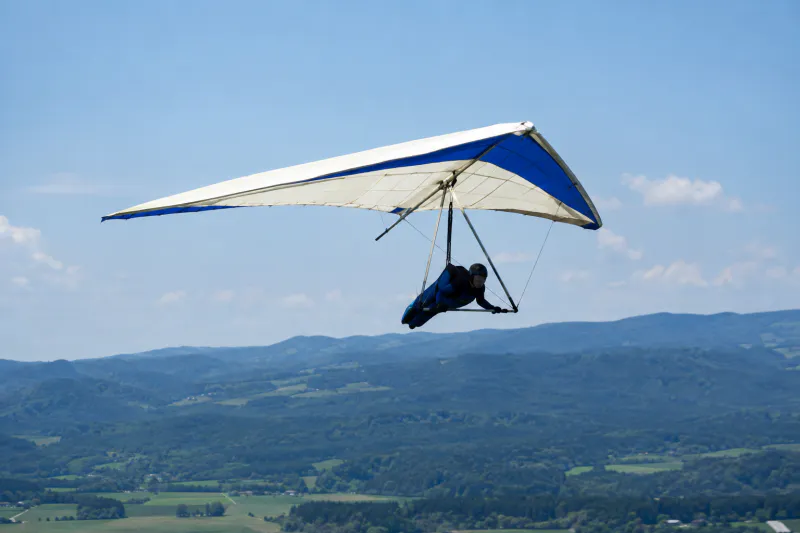
Hang gliding is flying a glider light enough to carry and launch on foot. The pilot lies prone in a harness under the wing, holds a triangular control bar and steers by shifting their weight. With rising air a flight can last hours: the distance record, flown from Zapata, Texas, in 2012, is 764 km in a single 11-hour flight.
The glider
A hang glider is an aluminium or carbon frame covered with a sail. Beginner gliders weigh 20 to 26 kg and performance gliders about 30 to 36 kg. Packed, most are a bag 4.7 to 6 m long that travels on a car roof, and many break down to under 4 m.
There are three kinds:
- Kingposted flex wings have a short mast on top of the wing and wires above and below it. Beginner gliders such as the Wills Wing Falcon and the Moyes Malibu are built this way, and so are many intermediate ones.
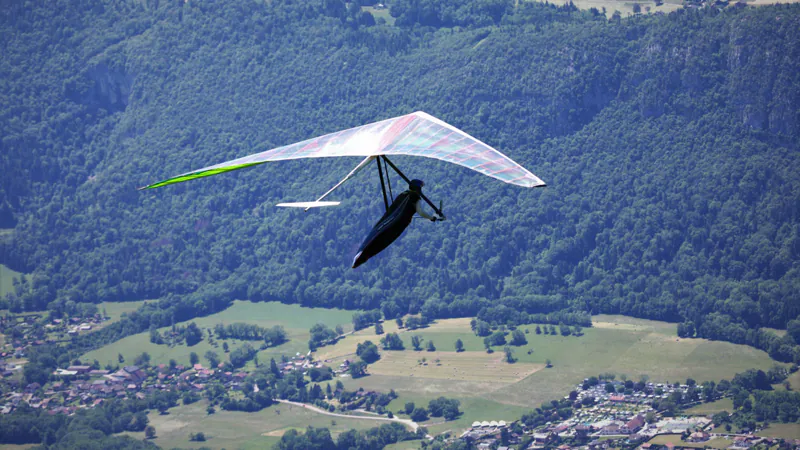
- Topless flex wings drop the mast and the top wires for less drag. These are the performance and competition gliders: the Wills Wing T3, the Moyes Litespeed, the Icaro Laminar.
- Rigid wings have a carbon structure, spoilers to turn and flaps to land slowly. On an ATOS, moving the control bar sideways works the spoilers, and weight shift still controls the pitch. They are the heaviest, at 35 to 44 kg.
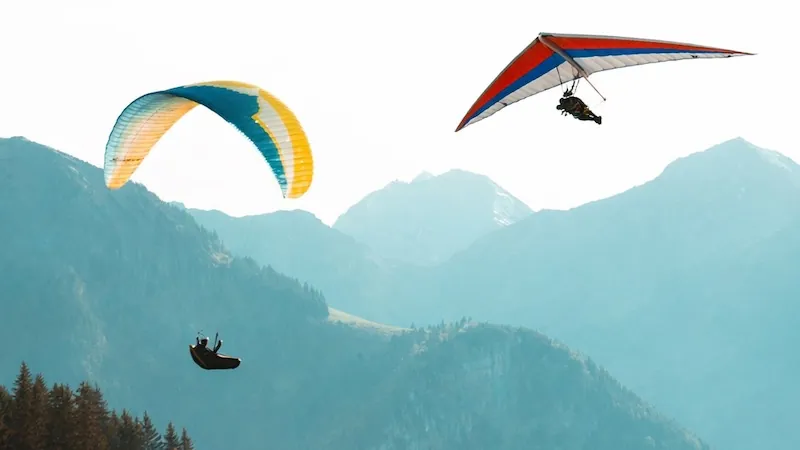
A hang glider is faster than a paraglider and glides further. A Moyes Litesport, a kingposted glider, covers 14 metres forward for every metre it sinks at 40 km/h, and still 10 at 58 km/h; a topless Litespeed RX glides about 15 to 1, and a beginner's Malibu 9.5 to 1. When Mike Harker flew from the Zugspitze in 1973, his glider managed about 4 to 1.
How a flight works
Most flights start with a run. On a hill, the pilot lifts the glider onto their shoulders, runs into the wind down a slope or off a ramp, and is flying after a few steps. In flat country, a microlight tows the glider up, or a winch on the ground pulls it up on a long line, and the pilot releases.
To stay up, the pilot uses rising air: wind pushed upwards by a ridge, or thermals, bubbles of warm air that rise faster than the glider sinks. A hang glider sinks at about 0.7 to 1 m/s in still air, so any air rising faster than that takes it up. Pilots circle in a thermal to climb, then glide to the next one, which is how cross-country flights cover hundreds of kilometres.
To land, the pilot swings upright under the glider and holds the sides of the control bar. In light wind they push the bar out at the last moment, a flare that stops the glider, and land on their feet with the glider settling on their shoulders. Rigid wings lower their flaps to come in slower.
Where it came from
Otto Lilienthal made the first repeated glider flights, some 2,000 of them, near Berlin from 1891, steering by moving his body, as hang glider pilots still do. He sold copies of one of his designs, the first aircraft built in series. He crashed in August 1896 and died the next day.
The modern hang glider comes from a kite. In 1948 Francis Rogallo, an American aeronautical engineer, and his wife Gertrude invented a flexible wing, patented as a flexible kite, which caught NASA's attention in 1958 as a way to bring space capsules back to earth; NASA chose parachutes in the end. In Australia, John Dickenson built a water-ski kite on a Rogallo-type wing and first flew it in September 1963, with a control bar and a harness hanging from the keel: the weight-shift system hang gliders still use.
The design spread quickly. In 1969 Bill Moyes foot-launched a Dickenson glider and soared a ridge, and Bill Bennett, who had moved to California to sell gliders, released from a tow and circled the Statue of Liberty twice. According to the FAI, Dickenson-type gliders went from a few dozen in 1969 to tens of thousands six years later. The US association had more than 10,000 members by 1974, and the first official world championships were held at Kössen, Austria, in 1976.
From the late 1980s, paragliding drew many of the newcomers. In Germany paraglider pilots have outnumbered hang glider pilots since 1993, and in France paraglider pilots make up most of the 38,000 or so members of the free-flight federation who fly. Hang gliding is a smaller sport today, but its schools, sites and competitions are still running.
Where people fly
- Rio de Janeiro: hang gliders and paragliders take off from separate ramps at Pedra Bonita, about 500 m above São Conrado beach, where they land. Hang gliding in Brazil started in Rio in 1974, and tandem flights are one of the city's most popular tourist activities.
- North Carolina: at Jockey's Ridge, the tallest living sand dune system on the Atlantic coast, beginners make their first short flights. Kitty Hawk Kites says it has taught more than 300,000 people since 1974.
- Lookout Mountain, Georgia: a flight park since 1978, with training hills, aerotows and a ridge over 20 miles (32 km) long.
- Zapata, Texas: the free-distance world records of all three hang glider classes, flex wings and rigid wings, started here.
- The Alps and beyond: Kössen and Greifenburg in Austria, the Tegelberg in Germany, Laragne in France and Monte Cucco in Italy have all hosted world championships, and so have Valle de Bravo in Mexico, Owens Valley in California and Governador Valadares and Brasília in Brazil.
How to try it
The easiest first flight is a tandem with an instructor. In the US, an aerotow tandem costs $199 to $399 at Kitty Hawk Kites in North Carolina or Lookout Mountain in Georgia, and lasts 8 to 30 minutes, depending on how high the tow plane releases you. In Rio, a tandem from Pedra Bonita costs R$ 800 to R$ 1,150 with photos or video and lasts 8 to 20 minutes. The minimum age is 14 in the US schools and 16 in Rio, and passengers can weigh up to about 100 to 113 kg.
To fly on your own, you start on a gentle slope or a dune: Kitty Hawk Kites' three-hour dune lesson, with five short solo flights, costs $149. In Britain, the first flights are often on a tether held by the instructor. Wills Wing says most students complete their initial training in 7 to 14 days. In the US, a course to the first solo rating costs about $1,200 to $2,750: Lookout's H2 package is $1,199, and Kitty Hawk's accelerated Hang II course, which includes 20 tandem aerotows, $2,750.
No licence is required by law in the US, but flying sites ask for a USHPA rating; the H2 (Novice) rating needs at least 25 flights and 8 hours of ground school, and solo ratings start at 16. In Britain the BHPA path runs from Elementary Pilot to Club Pilot, and in Germany the DHV issues the hang gliding licences.
A new beginner glider costs about $4,900 to $5,400 (the Wills Wing Alpha and Falcon 4), and used gliders in school shops go for $1,300 to $2,500. Lookout puts a beginner's gear at $4,000 to $10,000, new or used.
For the risks, is hang gliding safe goes through the accident figures, and hang gliding vs paragliding compares the two sports. Once you fly, Wingman for hang gliding turns an iPhone or an Apple Watch into a vario and a logbook, with take-off detection that also works on an aerotow.
Sources
- FAI: Otto Lilienthal
- Deutsches Museum: the Lilienthal glider
- Lemelson-MIT: Francis and Gertrude Rogallo
- FAI: John Dickenson
- Smithsonian National Air and Space Museum: Delta Wing Model 162
- FAI record 20814: 764 km free distance
- The Wills Wing story
- DHV: history (in German)
- Moyes Litesport specifications
- Kitty Hawk Kites: tandem hang gliding
- Lookout Mountain Flight Park: learn to hang glide