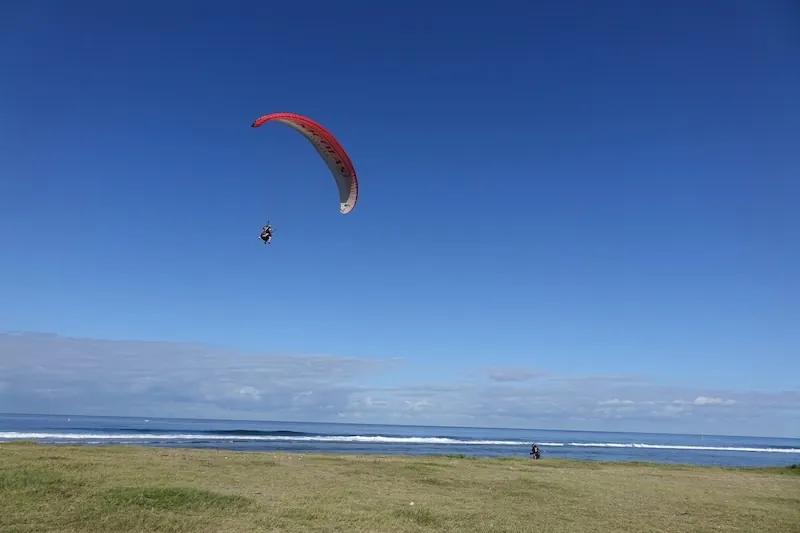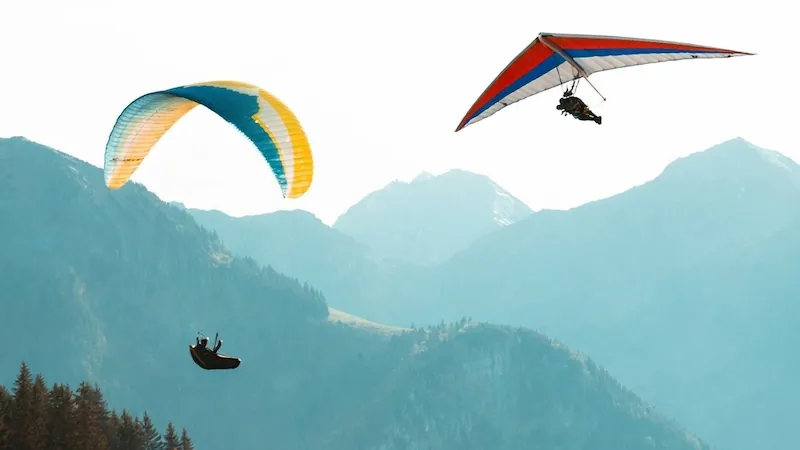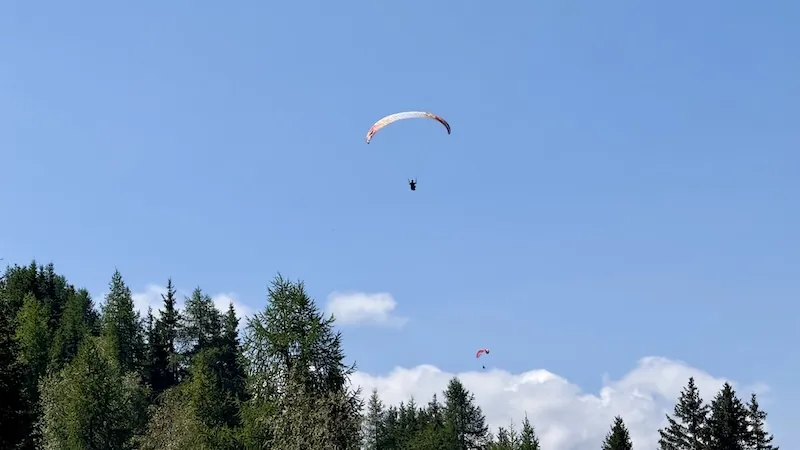
Paragliding is flying a fabric wing that you launch on foot. You lay the wing out on a slope, run a few steps into the wind, and it inflates and lifts you off the ground. There is no engine and no frame: the pilot sits in a harness under a canopy held in shape by air pressure, steering with two brake handles. It is the simplest form of human flight that can keep you up for hours.
Paraglider or parachute?
They look related, and the paraglider did evolve from the ram-air parachute, but they do different jobs. A parachute is built to slow a fall. A paraglider is a wing: it has an aerofoil section, a glide ratio of around nine or ten to one (nine metres forward for every metre down), and it is launched from a hill, not from an aircraft.
How a paraglider stays up
Left alone, a paraglider sinks at roughly one metre per second. Flights last hours because pilots find air that is rising faster than that.
Thermals
When the sun heats the ground, warm air breaks away and rises in columns. A pilot who finds one circles inside it and climbs with it, at anything from a gentle one metre per second to five or more on a strong day, often all the way to cloudbase. In the Alps in summer that can be well above 2,500 m.
Ridge lift
Wind that meets a slope is pushed upward. Flying back and forth along the ridge in that band of rising air keeps you up for as long as the wind blows. Coastal cliffs and evening flights on a mountain face are the classic examples.
Reading which air is going up, and where it will be in a few minutes, is most of the skill. The instrument that helps is the variometer, which beeps faster the faster you climb. On a phone it is now good enough that many pilots use nothing else; how a phone vario works explains why.
How long is a flight?
A tandem flight, or a beginner's first solo flights: 10 to 20 minutes, top to bottom. An experienced pilot on a good day: several hours, and cross-country flights of 100 km or more are routine in the Alps in summer. The world record is over 600 km.
What it feels like
Quieter than you expect. Once the wing is overhead and your feet leave the ground, the running stops and everything goes still: no engine, just wind noise. In smooth evening air it is like sitting in a chair that happens to be a thousand metres up. In thermals it is more physical: the wing surges and pulls, the vario beeps, and you work to stay in the lift. Most first-timers are surprised by how calm it is, and by how quickly it feels normal.
Is it safe?
Short version: it is a moderate-risk sport in the same band as skiing or scuba diving, and most of the risk depends on training and weather decisions. The long version is in is paragliding safe.
How to try paragliding
- Tandem flight. No training, a short briefing, a few running steps, and a licensed pilot does the flying. Available at most flying sites and the usual first step.
- Beginner course. Typically one to two weeks at a certified school: ground handling, low flights on a training slope, then supervised high flights. Schools are licensed by national federations (FFVL, DHV, USHPA, BHPA).
- Equipment. Rent during training. When you buy: an EN-A or EN-B wing, a harness, a reserve parachute, a helmet. The instrument can be your phone.
If you are wondering where to go, the best paragliding destinations lists six sites worth a trip, and hang gliding vs paragliding explains the difference from its rigid-wing cousin.