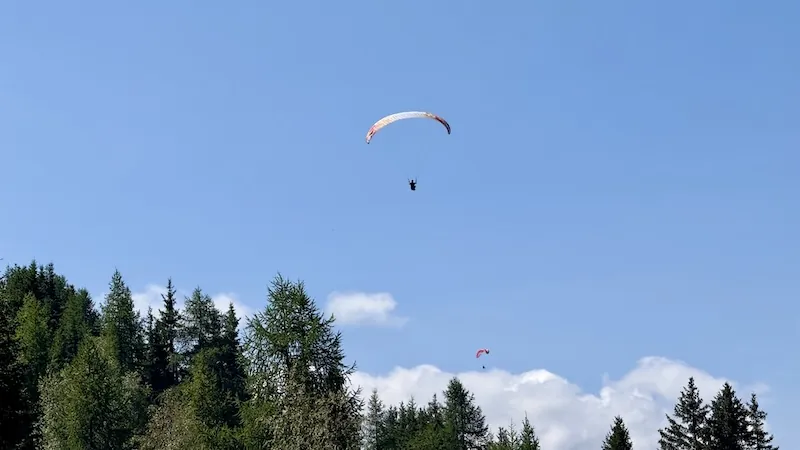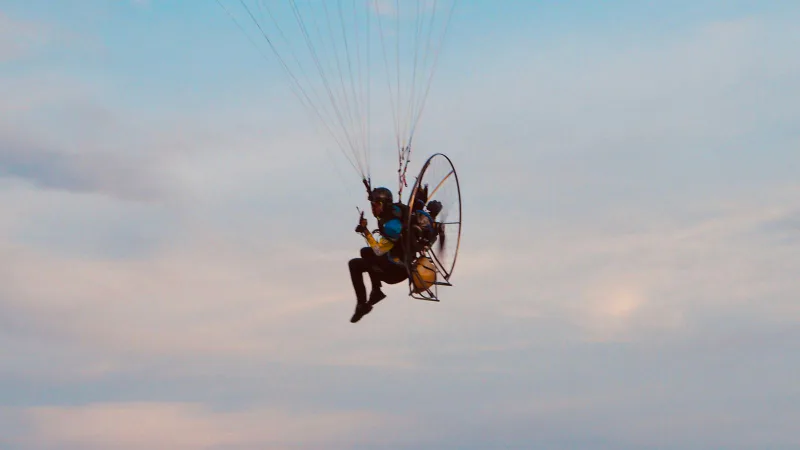
Paramotoring, also called powered paragliding or PPG, is flying a paraglider-type wing with a small engine and a propeller on your back. You take off from a flat field, on foot or with a wheeled trike, and climb under power, so you need no hill and no thermals. Cut the engine and the paramotor glides down like a paraglider.
Most flights are low and slow, at 40 to 50 km/h over fields, coasts and deserts, but a paramotor can also go a long way: the distance record, flown non-stop in 2007 from Jerez in southern Spain to Lanzarote in the Canary Islands, is 1,105 km.
How a paramotor works
The paramotor is a frame that carries a harness, a two-stroke engine of 80 to 185 cc, a fuel tank and a propeller in a protective cage, 1.3 m across on Parajet's Maverick II. You wear it like a backpack and hold the throttle in one hand. Most units weigh 20 to 30 kg: Parajet's Maverick Cadet weighs 20.5 kg with a Vittorazi Atom 80 engine and 24 kg with a Moster 185.
The engine pushes you forward and the wing turns that speed into lift, so you climb when you open the throttle. Vittorazi's Atom 80 gives 55 kg of thrust and its Moster 185 Plus 78 kg, and at cruise power they burn 2.7 and 3 litres of fuel an hour. Parajet's advice is a unit that weighs less than 30% of your body weight and pushes more than 70% of it, and a climb of 1 to 1.5 m/s is plenty. A 16.5-litre tank holds fuel for several hours.
The wing looks like a paraglider, and sometimes is one, but many pilots fly reflex wings, built for powered flight. Their profile keeps them stable at speed: Ozone says its Viper 5 “will resist reasonable levels of turbulence without pilot input”. A reflex wing such as the Dudek Nucleon 4 flies at 42 to 53 km/h on its trimmers and up to 67 km/h. Under full power, the engine's torque tries to turn the wing, and the pilot corrects it with weight shift or the trimmers.
Electric paramotors are quiet and need no fuel, but they fly for less time. OpenPPG's SP140, for example, gives 75 kg of thrust and flies 20 to 40 minutes on its 2.6 kWh battery, or 50 to 80 minutes on the 4.8 kWh one, which makes the unit 35.7 kg instead of 24.5 kg. A charge takes two to five hours, and the unit costs $7,268 to $8,982 without a wing.
Foot launch or trike
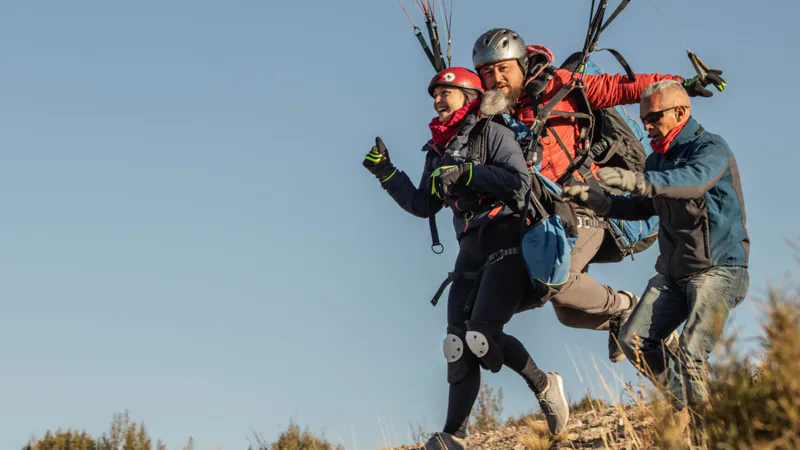
Most pilots take off on foot. In no wind or a light breeze you run forward and the wing comes up behind you (a forward launch); in more wind you face the wing, bring it overhead, turn round and go (a reverse launch). Then you open the throttle and keep running until the wing lifts you. Running with 25 kg on your back while keeping the wing straight above you takes practice.
A trike is a wheeled frame with a seat: the engine does the running, so it suits pilots who can't run a take-off, and flying with a passenger. In France both are class 1 microlights (ULM), and Germany's Motorschirm licence covers both. In the UK, the rules that let you fly without a licence cover a wheeled paramotor only up to 70 kg with fuel.
Paramotor or paraglider?
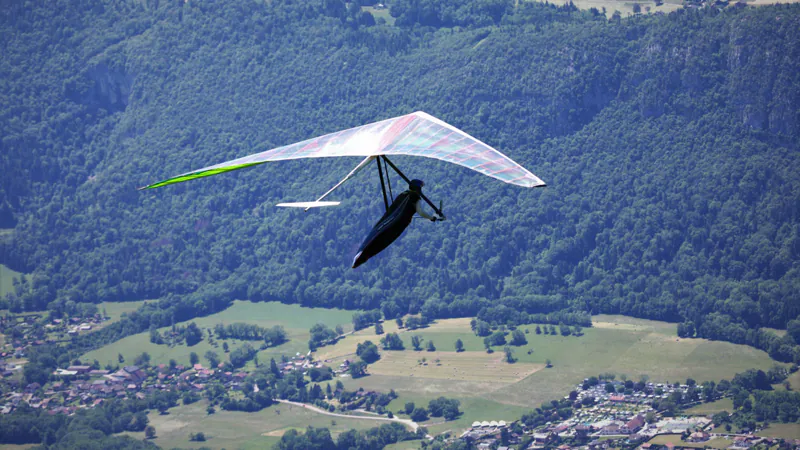
Under the wing, the flying is much the same: you steer with the brakes and your weight, and with the engine off you glide like a paraglider. What changes is where you start and what keeps you up. A paraglider needs a hill or a winch to take off and rising air to stay up, so it flies on days with thermals or a steady wind on a slope. A paramotor takes off from a field and stays up on its engine, so it can also fly in the calm air of early morning and evening. In exchange you carry 20 to 30 kg, buy fuel, make noise and, in many countries, need a licence. Some paraglider pilots add a paramotor to fly where there are no hills; what is paragliding covers the unpowered side.
What it costs
New, a petrol paramotor costs about £6,400 for a Parajet in the UK and $5,700 to $9,000 for an OpenPPG in the US, and a wing adds $3,000 to $5,000. Schools put all the gear at $7,500 to $12,000 (Aviator PPG, in the US) or £8,000 to £10,000 (Parajet, in the UK). Training costs about $3,400 to $3,850 in the US and £1,000 to £2,500 in the UK. After that, fuel is the main cost, at about 3 litres an hour.
Do you need a licence?
It depends on the country:
- United States. No. A paramotor is an ultralight under FAR Part 103: no pilot certificate, medical or registration, as long as it weighs under 254 lb (115 kg) empty and carries one person and at most 5 US gallons (19 litres) of fuel. Training is voluntary; the USPPA's ratings go from PPG1 (ground school, a written test and two flights) to PPG3 (90 flights and 20 hours solo).
- United Kingdom. No licence for a foot-launched paramotor, but the CAA's Paramotor Code strongly recommends training. Parajet's training takes about 10 to 12 days.
- France. The microlight (ULM) pilot licence for the paramotor class: a theory exam of 60 questions in 90 minutes, with 75% to pass, and a flight test. The French microlight federation's training programme counts about fifteen take-offs on average.
- Germany. The sport pilot licence with the Motorschirm rating, from age 17: 30 lessons of theory, at least 40 take-offs and landings over four days or more, including three cross-country flights, and a test with a DULV examiner. Liability insurance is compulsory.
- Spain. No licence: the ultralight rules leave paramotors out. Since April 2026, those rules set the limits for paramotors: by day, below 3,000 m, outside controlled airspace and away from towns, with a harness and a helmet.
- Brazil. An aerodesportista certificate through an accredited association, free and without expiry, from age 18, and the paramotor must be registered.
- Italy. The VDS certificate from the Aero Club d'Italia: at least 33 hours of theory and 16 of practical training at an approved school, including 4 solo flights, then a theory exam, a flight test and a medical certificate. The paramotor must be registered and insured.
These are the rules as of November 2026.
How to learn
At a school. You start on the ground, learning to bring the wing up and keep it overhead, first without the engine, then with the paramotor on your back. Then come the first flights, alone under the wing, usually with the instructor talking you through them on the radio. How many it takes depends on you and the weather: about fifteen take-offs in France, at least 40 in Germany, 25 or more for the USPPA's PPG2 rating.
Is paramotoring dangerous?
It has the risks of paragliding, plus those of an engine and a propeller. In the UK, a study of the BHPA's accident reports from 2000 to 2014 counted 83.4 deaths a year per 100,000 people flying paramotors, against 47.1 for paragliding and 40.4 for hang gliding. In France, the BEA recorded three fatal paramotor accidents in 2023 and three in 2024, out of 18 and 9 fatal microlight accidents.
Source: Feletti et al. (2017), from the BHPA's accident reports
Where things go wrong is well known. Of 383 accidents reported voluntarily to the USPPA between 1995 and 2012, 43% happened at take-off, including the inflation of the wing. Pilot error was the main cause in more than half, and engine trouble in 15%. The propeller was involved in 11%, with 11 finger amputations, and five of the 23 deaths were drownings after a landing in water. The BEA's three fatal accidents of 2023 involved twisted risers on a high-performance wing in turbulence and a low power line hit with the sun ahead; the cause of the third is unknown.
Take-offs, the propeller, power lines and water: that's where training and care make the difference.
Where can you fly?
You need a field and the permission of whoever owns it. After that, the rules are much the same everywhere: fly by day, keep out of controlled airspace unless air traffic control allows it, and stay away from towns and crowds. Some examples:
- United States. Not over congested areas or crowds, from sunrise to sunset (30 minutes more at twilight with an anti-collision light, outside controlled airspace), and in national parks only at designated sites.
- United Kingdom. A field without planning permission can be used on 28 days a year at most. Keep 500 ft from people, vehicles and buildings, and 1,000 ft above congested areas.
- France. A site used now and then must be declared to the mayor, and flying is by day only.
- Germany. Away from an airfield, a take-off needs the landowner's consent and a permit from the aviation authority.
- Italy. No higher than 150 m (500 ft) above the highest obstacle within 5 km, or 300 m (1,000 ft) at weekends and on national holidays. At least 5 km from airports, never over towns, railways or crowds, and from June to September no lower than 300 m over beaches.
Where paramotoring came from
According to the FAI, the British pilot Mike Byrne built a powered unit for a paraglider wing in the early 1980s and called it a paramotor. In France, Gérard Feldzer made the first crossing of the Channel by paramotor in October 1984, taking off on wheels, and the hang glider maker La Mouette began developing its own paramotor in 1986. The FAI recognised the first paramotor record in 1995, 179.4 km around a closed circuit, and held the first world championships in 1996, in South Africa.
Instruments
Paramotor pilots fly with the same instruments as paraglider pilots, often on a phone or a watch: a vario, a GPS for speed, altitude and the track, and the airspace on a map. The vario still matters under power: in a thermal you can throttle back and climb on rising air instead of fuel. You won't hear its beeps over the engine, though, so pilots mount the phone where they can see it, send the sound to the headset in their helmet, or wear a watch that taps the wrist in lift. Wingman for paramotor pilots does all three on the iPhone and the Apple Watch, and logs every flight; more about its vario.
Sources
- FAI: paramotoring
- FAI: paramotor records
- Guinness World Records: farthest non-stop flight by a powered paraglider
- Guinness World Records: first crossing of the English Channel by paramotor
- La Mouette: our history
- Vittorazi Atom 80 specifications
- Vittorazi Moster 185 specifications
- Parajet Maverick Cadet
- Parajet Maverick II LE
- Parajet: choosing the right paramotor
- Parajet: paramotor prices
- Parajet: paramotor training
- Ozone Viper 5 manual
- Dudek Nucleon 4 specifications
- OpenPPG: electric paramotors
- OpenPPG: paramotor prices
- Aviator PPG: paramotor training
- 14 CFR Part 103, ultralight vehicles
- USPPA training program
- UK CAA: paramotors and powered hang gliders
- UK CAA: The Paramotor Code (CAP 2562)
- French ministry of transport: microlight pilots (in French)
- DULV: Motorschirm (in German)
- Spain, Royal Decree 182/2026 (in Spanish)
- Brazil, ANAC RBAC 103 (in Portuguese)
- Italy, DPR 133/2010 (in Italian)
- BEA annual report 2023 (in French)
- BEA annual report 2024 (in French)
- BEA: safety lessons for microlights
- Feletti et al. (2017): fatalities in powered paragliding, paragliding and hang gliding in the UK
- Feletti and Goin (2014): powered paragliding injuries in the US, BMJ Open