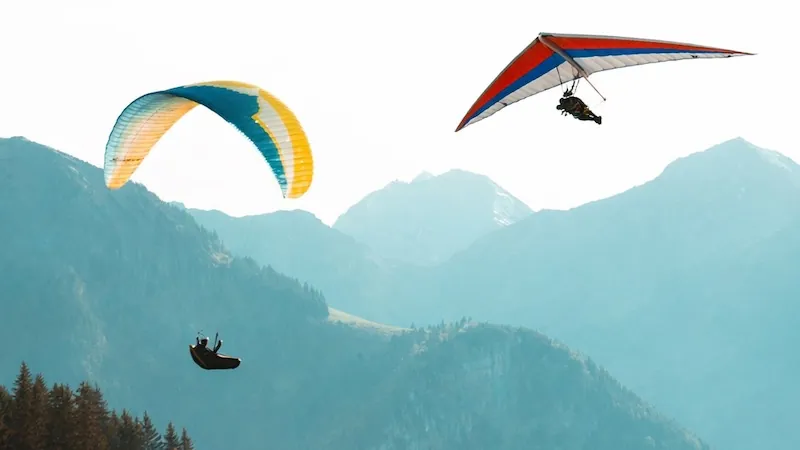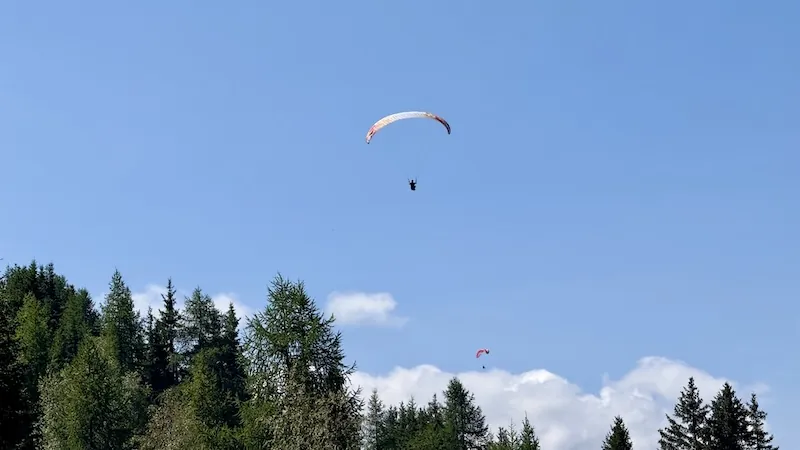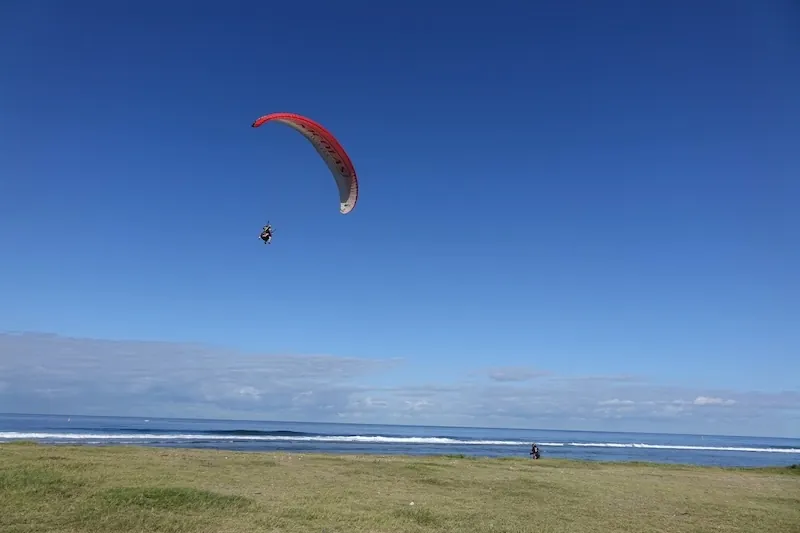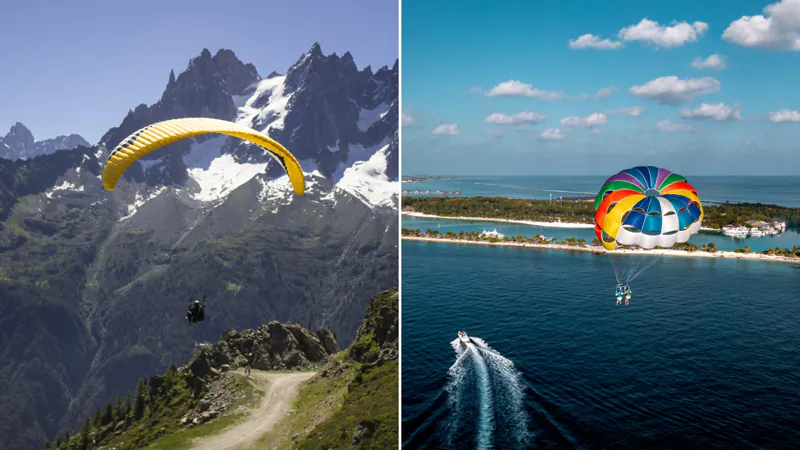
On a summer afternoon at Ölüdeniz, on the Turkish coast, you can watch both from the same beach. Out in the bay, a speedboat tows a round canopy on a long rope, with two people hanging under it. Overhead, wings drift down from Babadağ, the mountain behind the town, and land on the beach. The first is parasailing, the second paragliding.
The names are close, and both hang people under fabric, but they are not two versions of the same activity. In parasailing you are towed: the boat does the work, the crew decides everything, and you stay on the end of the rope from start to finish. A paraglider is a glider. Once it leaves the hill nothing connects it to the ground, and a pilot flies it, using rising air to stay up.
At a glance
| Parasailing | Paragliding | |
|---|---|---|
| What it is | A canopy towed on a line behind a boat | A glider that flies free once launched |
| Who is in control | The boat crew; passengers have no controls | The pilot: an instructor on a tandem, or you once trained |
| Training | None, just a briefing | None for a tandem; one to two weeks of school to fly solo |
| Take-off and landing | From the deck of the boat, and back onto it | A few running steps down a slope; landing in a field or on a beach |
| Height | Usually 50 to 150 m above the water | From about 100 m along a coastal cliff to 2,000 m above a valley |
| Time in the air | 8 to 15 minutes | 10 to 30 minutes on a tandem; hours for a trained pilot |
How parasailing works
A parasail looks like a round parachute, but it is cut to climb when it is pulled: slots at the back of the canopy turn the incoming air downward, and that produces lift. Most operators now fly from a winch boat. You are clipped into a harness on a flat deck at the stern, the crew pays out line from a hydraulic winch, and the canopy lifts you off the deck. At the end the winch reels you back in, and you step down where you started, usually dry. If you ask, some crews will slow the boat to dip your feet in the water.
The length of line and the speed of the boat set the height, usually somewhere between 50 and 150 metres. In the United States the FAA treats a parasail as a kite, which caps it at 500 feet (about 150 m) and keeps it 5 miles from airports unless the operator has a waiver. The flight itself lasts 8 to 15 minutes. Several groups usually share the boat and take turns, so the whole trip takes an hour or more.
Up there you are a passenger in the strict sense: no brakes, no steering lines, no way to change height or direction. Everything depends on the crew below, and for many people that is the appeal. One to three people can fly on the same bar, which makes it popular with couples and families. Children usually go up with an adult, because each canopy has a minimum weight as well as a maximum.
How paragliding works
A paraglider is a wing, with an aerofoil section like an aircraft's. It glides about nine metres forward for every metre it sinks, and it needs no boat and no rope: you take off on foot from a slope facing into the wind, and from then on it flies by itself, steered by the pilot with two brake lines.
Left alone, it would glide gently down to the landing field. Flights last longer because pilots use rising air: thermals, columns of warm air that rise from sunny ground, and ridge lift, where the wind is pushed up a slope. On a good day a trained pilot stays up for hours and can fly more than 100 km.
Most people start with a tandem flight. You sit in a harness in front of a qualified tandem pilot, run a few steps at take-off, and the pilot does the rest; many will hand you the brakes for a few turns if you ask. A tandem flight lasts 10 to 30 minutes, longer when there is lift, and lands in a field or, at coastal sites, on the beach. At Ölüdeniz the take-off on Babadağ is 1,700 to 1,900 metres above the sea, so even a flight without lift is a long, quiet descent over the lagoon.
One detail confuses people: paragliders can be towed too. In flat country, with no hill to launch from, pilots are pulled up by a winch. At the top the pilot releases the line and glides away. For a paraglider the tow is only a way to get airborne; for a parasail it is the whole flight.
Why the names are so close
Both come from the parachute. Parasailing started in 1961, when a parachute developer modified a canopy to climb behind a vehicle, so that parachutists could train without an aircraft. The winch boat that turned it into a beach activity followed in the 1970s. Paragliding came later: in 1978, parachutists at Mieussy in the French Alps ran down a slope with square canopies and glided to the valley. Paragliders have been designed to glide ever since, while parasails are still built to climb on a rope.
What it feels like
Parasailing is smooth and slow. The canopy is big and stable, the boat is a small shape far below, and the noise drops to wind and the distant engine. Most people find it peaceful. If you get seasick, the boat ride and the wait while the others fly are more likely to bother you than the flight.
A tandem paraglide starts with a little effort: you lean forward and run while the wing comes up behind you, and then the ground drops away. In calm evening air the flight is as smooth as a parasail ride. In thermals it moves more: the wing rocks and surges, you climb in tight circles, and you can feel the air working. Some pilots finish with spirals or wingovers. They are optional; if you want a calm flight, say so before take-off.
Who can do it
Parasailing asks almost nothing of your body. You sit or stand on the deck, the canopy lifts you off, and you come back the same way. Operators set weight limits rather than fitness requirements.
A tandem paraglide needs a few running steps at take-off and the ability to stand up or slide in on landing. Passenger weight limits are usually between 90 and 110 kg, and many schools fly children from about six if they are heavy enough for the wing. Limits vary, so check with the operator before booking.
What they cost
Parasailing is usually the cheaper of the two. In US beach towns a ride typically costs $50 to $100 per person, more in Hawaii, and on the French Riviera €50 to €90. A tandem paragliding flight at Torrey Pines in San Diego costs $200 to $275, and over Lake Annecy in the French Alps €85 to €180, depending on how long you fly.
Which is safer?
Both have a good record when they are run well, and in both the person in charge makes most of the difference.
With parasailing, almost all of the risk sits with the operator. In 2014 the US National Transportation Safety Board reviewed the industry after a series of fatal accidents. It estimated that 3 to 5 million people go parasailing in the US every year, and found that in all but one of the serious accidents it examined, the equipment had failed: tow lines that snapped in strong wind, a worn-out harness. When the line breaks, the canopy is designed to come down like a parachute, but in strong wind it can drag its passengers across the water or the beach. At the time, no federal rule required crews to stop in bad weather. Florida now sets limits by law: no parasailing when the sustained wind is above 20 mph, when gusts exceed 25 mph, or when a thunderstorm is within 7 miles.
The practical advice follows from that: look at the sky yourself. If the wind is strong and gusty, or a storm is building, don't go up, whatever the crew says. A good operator will have cancelled already.
Tandem paragliding also comes down to the pilot and the weather. Tandem pilots need a separate tandem rating on top of their pilot licence, and most incidents happen at take-off, at landing, or in conditions that were too strong. That is why good tandem pilots cancel more often than their customers would like. The details are in is paragliding safe.
Which one to choose
- A relaxed outing on a beach holiday, with family, no running and nothing to learn: parasailing.
- To find out what flying feels like, with turns, climbs in a thermal and a view down a valley: a tandem paraglide.
- If you might want to fly on your own one day: paragliding. On a parasail you are always a passenger, while a tandem flight is how many pilots started.
If a tandem flight leaves you wanting more, what is paragliding explains how the sport works and how to learn it. Once you fly on your own, an app such as Wingman on your iPhone or Apple Watch can be your first vario and flight log.