In a weak thermal a paraglider can climb at half a metre per second without the pilot feeling it. The inner ear senses changes in speed, not a steady climb, so once the first push in the harness has passed, rising gently and sinking gently feel the same. A variometer, or vario, is the instrument that tells them apart, and almost every paraglider and hang glider pilot flies with one.
What a vario measures
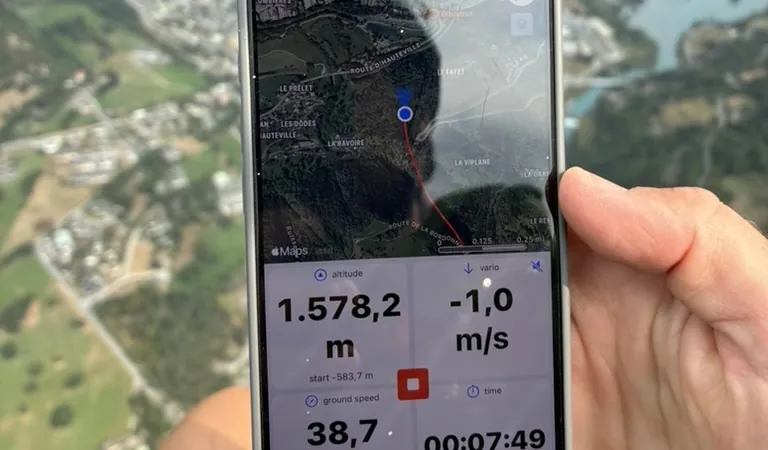
A vario shows vertical speed: how fast you are going up or down, usually in metres per second, sometimes in feet per minute or knots. One metre per second is about 197 ft/min, or just under 2 knots.
It measures you and the air together. A paraglider sinks through still air at about 1 m/s at its slowest (Mac Para lists 1.05 to 1.1 m/s for its school and intermediate wings), so when the vario reads zero, the air around you is rising at about 1 m/s.
In flight the numbers are small. A 2026 analysis of 110,730 paragliding flights put the average climb in thermals at about 1 m/s in flat country and 1.3 m/s in high mountains. Thermals are also stronger in the middle than at the edges: in an example from Burkhard Martens' book Thermal Flying, a thermal that rises at 1 m/s overall climbs at 2 m/s in its centre.
Why you can't feel it
You do feel the moment you fly into a thermal: a push in the harness, the wing pitching back. What you can't feel is what comes after. Whether you are climbing at 0.3 or 2 m/s, and whether one side of your circle is better than the other, takes an instrument. Glider pilots use both: the FAA's glider handbook tells them to react to the surge they feel, because the vario shows it a couple of seconds later.
How it works
Air pressure falls as you climb, by about 12 pascals per metre near sea level, or one hectopascal for every 8 metres or so. A modern vario reads a pressure sensor many times a second and turns the change into a climb rate. The sensors are small and precise: the MS5611, a sensor made for altimeters and varios, resolves 0.012 millibar, about 10 cm of height.
The difficulty is noise. Air moving around the instrument makes the pressure jitter, so the vario averages the readings, and averaging adds delay. Flymaster's manual puts it simply: a lower damper setting makes the vario more responsive, but harsher. A vario that reads only pressure can lag by up to two seconds, the delay the XC Tracer was designed to remove.
Newer instruments cut that lag with motion sensors. XC Tracer, Skytraxx and Syride combine the pressure sensor with an accelerometer, and some models also with a gyroscope and a compass: the accelerometer notices the push of a thermal at once, and the pressure sensor confirms it a moment later.
GPS alone makes a poor vario. The US government's GPS performance standard allows a vertical error of up to 13 metres (95% of the time, global average), against 8 metres horizontally. That is fine for a track log but far too coarse to show a climb of half a metre per second, which is why XCTrack, a popular flight app, offers its audio vario only on phones with a pressure sensor.
What the beeps mean
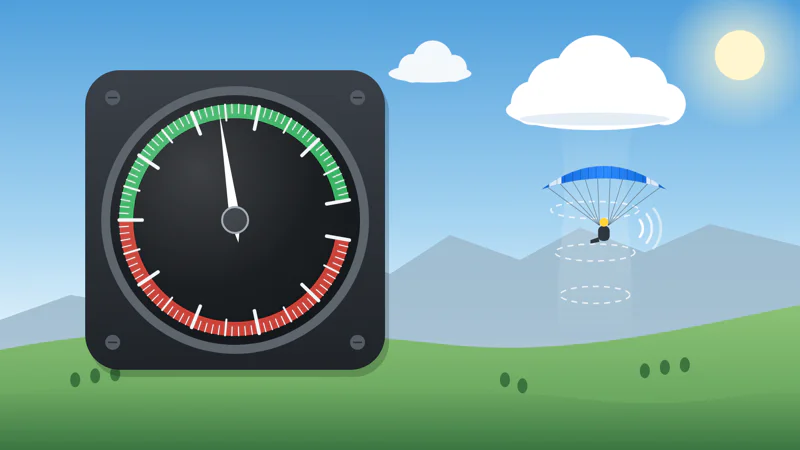
When you climb, a vario beeps, and the beeps get faster and higher as the climb gets stronger. On a Flymaster, for example, the tone starts at 700 Hz and reaches 800 Hz at 1 m/s. Sink gets a continuous low tone.
Most varios start beeping at +0.1 or +0.2 m/s and only sound the sink alarm below −2 to −3 m/s, so ordinary gliding stays quiet. Some add a buzzer, a buzzing sound when the air is rising but not yet enough to make you climb, which tells you lift is near.
The screen usually shows an average as well: over the last 6 seconds by default on a Flymaster, up to 20 seconds on an XC Tracer, roughly the time of one full turn. It tells you whether the thermal as a whole is worth staying in, while the beeps tell you where its core is.
Where the vario comes from
Balloonists used instruments for climb and descent before glider pilots did. In the late 1920s, the meteorologist Walter Georgii and the glider designer Alexander Lippisch adapted one for gliders, and Georgii asked a young Austrian pilot, Robert Kronfeld, to test it on the Wasserkuppe in Germany, and to tell nobody about it. Flying the Professor, a Lippisch design, Kronfeld used it to find thermals under cumulus clouds. In May 1929 he flew 102.5 km, a world record at the time.
Those early varios were mechanical. An insulated flask, like a small thermos, is connected to the outside air through a thin tube; when you climb and the outside pressure falls, air flows out of the flask, and an indicator on that flow shows the climb. The flask takes several seconds to catch up, so those varios were slow. The first variometer for hang gliders, made by Frank Colver, appeared in the early 1970s.
Kinds of varios and what they cost
- Audio varios: a small box that beeps, with no screen or a tiny one. The Skytraxx Tweety-Pro and the Skybean 2 cost about €100, and the Syride Solar, which also records the flight, €119.
- GPS varios: a screen with altitude, speed and glide ratio, an IGC track log for online contests, airspace warnings and competition tasks. From about €350 (Syride Vario GPS V4) to €689 (Skytraxx 5) and €1,279 (Flymaster Live DS).
- Bluetooth varios: a sensor box that sends climb rate and pressure to an app on your phone, which does the screen, the map and the log. A BlueFly costs A$125 and an XC Tracer Mini V €565. Most use standard formats such as LK8EX1, so they work with several apps.
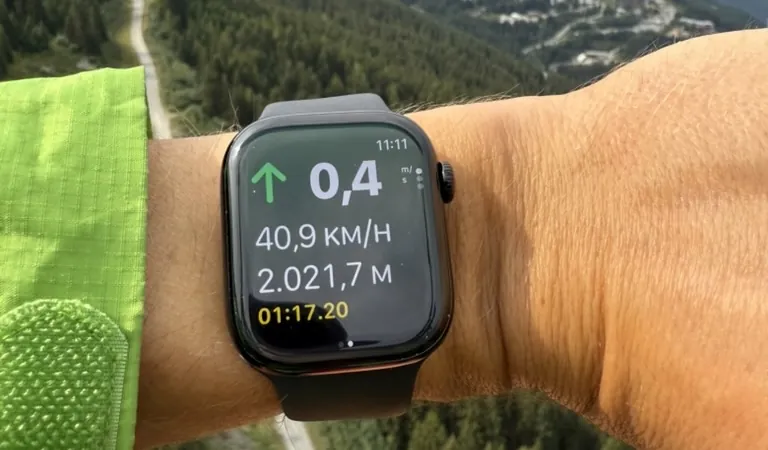
- The phone itself: every iPhone since the iPhone 6 (2014) has a barometer, and so has the Apple Watch since the Series 3 (2017), so an app can turn either into a vario. How well that works depends on how the app filters the readings.
Prices in euros are from a large German retailer, in October 2026.
Setting it up
Two settings matter before the first flight. The first is altitude. A pressure sensor measures height against a reference pressure, and the pressure at sea level changes with the weather, so set the altitude of take-off before you launch, as Flymaster recommends before every flight, or let the instrument take it from GPS if it can. Airspace limits given as flight levels are the exception: they are always worked out from the standard pressure of 1013.25 hPa, and a good instrument does that for you.
The second is the thresholds. If the vario beeps all the time you will stop listening to it, so start with the climb tone from about +0.1 or +0.2 m/s and the sink tone below about −2 m/s, and adjust after a few flights.
To fly with your phone, best vario app for iPhone covers what to look for. Wingman uses the barometer and accelerometer of the iPhone or the Apple Watch for its vario, with sound and adjustable thresholds, and records every flight in your logbook.
Sources
- FAA Glider Flying Handbook (FAA-H-8083-13A)
- Flymaster GPS LS2 user manual
- XC Tracer Maxx III user manual
- GPS.gov: GPS performance
- arXiv 2608.00241 (2026): climb rates from 110,730 paragliding flights
- Burkhard Martens in Cross Country: an extract from Thermal Flying
- Mac Para Progress 2 specifications
- Soaring Web: Robert Kronfeld
- Wikipedia: RRG Professor